
Construction
Construction Debris Disposal in Virginia: The Real Sequence
The loading is simple. The paperwork sits with three agencies and keys off three different years. Here is the order a Roanoke Valley demo job actually runs in.
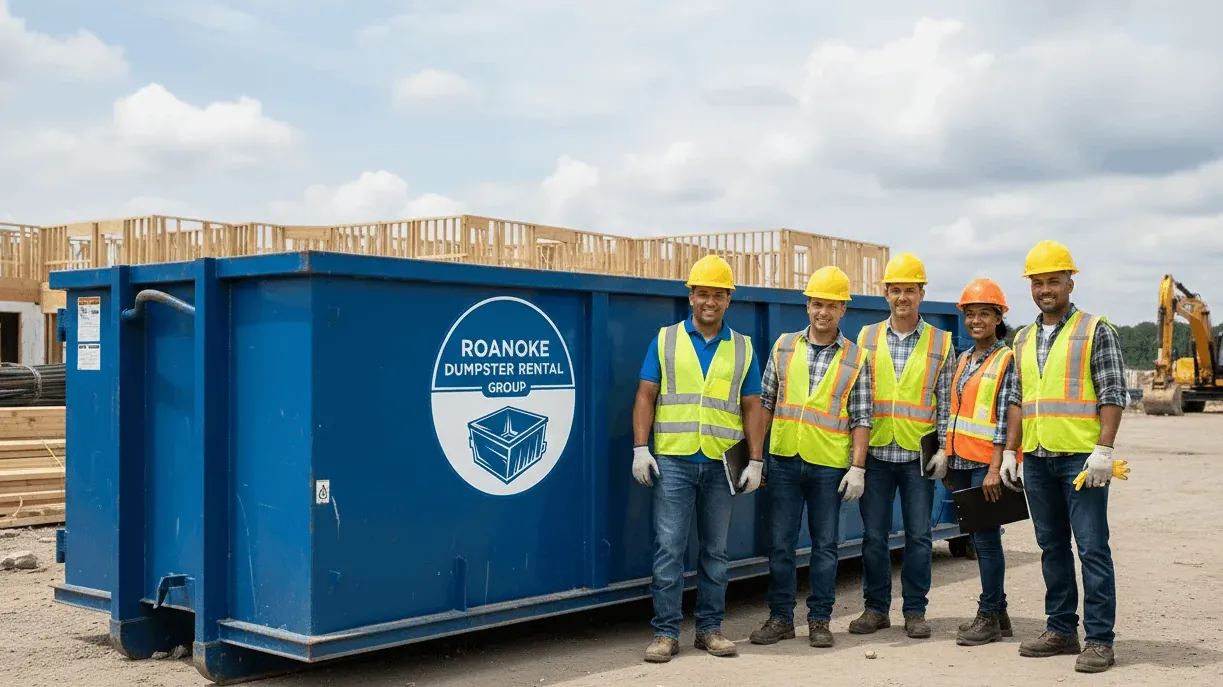
Construction debris in Virginia is easy to handle and easy to get wrong, and the two things are unrelated. The loading is straightforward. The paperwork sits with three different state agencies, keys off three different vintage dates, and none of it is the same as the dumpster permit. This page lays the sequence out in the order a Roanoke Valley job actually runs.
We are a hauler, not your lawyer or your building official. What follows is what we have learned putting boxes on job sites in this valley since 2012, with the code sections named so you can check them yourself.
Three agencies, three jobs
Virginia splits asbestos and lead work across three state bodies, and most bad advice on the subject comes from someone who thinks it is one.
- DPOR — the Department of Professional and Occupational Regulation — licenses the people and firms. Asbestos and lead licensing runs through the Virginia Board for Asbestos, Lead, and Home Inspectors.
- DOLI — the Department of Labor and Industry — takes the notifications and runs the workplace safety side.
- DEQ — the Department of Environmental Quality — governs where the waste can legally go, under 9VAC20-81.
Licensing, notification, disposal. Three agencies, three questions, and answering one does not answer the others. Their sites are DPOR and DOLI.
The three dates that decide what your job needs
Virginia layers a federal rule and a state rule on top of a plain market fact, and each has its own year. Mixing them up is the single most common error we see on renovation jobs here.
| Date | What it triggers | Who runs it |
|---|---|---|
| Built before 1 January 1978 | EPA Renovation, Repair and Painting rule — lead-safe work practices in housing and child-occupied facilities | EPA, administered federally in Virginia |
| Initial building permit before 1 January 1985 | Va. Code § 36-99.7 — no local building permit for renovation or demolition without a licensed asbestos inspection | Your local building official, with DPOR-licensed inspectors |
| Built before 1960 | Not a rule. 55% of City of Roanoke housing, per the City’s own housing page | Nobody — it is a market fact |
The headline for this valley falls out of that table on its own. More than half the houses in the City of Roanoke were built before 1960, which means most city renovation work sits in pre-1978 housing and falls under the federal RRP lead rule. Do not apply that 55% figure to Roanoke County — the county’s stock is considerably newer.
The pre-1985 asbestos gate
Va. Code § 36-99.7 is a permit gate, which is what makes it bite. A locality may not issue a building permit for the renovation or demolition of a building whose initial building permit predates 1 January 1985 unless a licensed asbestos inspection has been performed.
The exemption is narrow, and it is worth quoting rather than paraphrasing: residential buildings of four units or fewer are exempt unless the work is for commercial or public development purposes.
Read both halves of that. A single-family house, a duplex, a triplex or a fourplex in Roanoke is generally exempt from the pre-permit inspection. A five-unit or larger residential building is not. Any commercial building permitted before 1985 is not. And even a house loses the exemption if the work is being done for commercial or public development purposes.
Two ways to be wrong here, and we hear both. It is wrong to say Virginia requires an asbestos inspection before any demolition, because most houses are exempt. It is equally wrong to say houses are always exempt, because of that carve-out. Quote the statute and stop.
Note the date too. It is 1985, not 1978. The lead date and the asbestos date are different years and they are administered by different bodies. In a city where over half the stock predates 1960, a great many buildings clear both thresholds by decades.
What we do about asbestos
We do not accept asbestos in our containers. In Virginia an asbestos project runs through a DPOR-licensed contractor with DOLI notification, and the waste goes to a facility permitted to take it under 9VAC20-81. If you suspect asbestos in pipe insulation, floor tile, mastic, siding or duct wrap, stop and get it identified before you start filling a box. Sorting it out of a loaded container is not a thing that can be done.
Demolition: tell DOLI ten working days ahead
This one surprises people, so we lead with it on every demolition job we quote.
Virginia DOLI must be notified 10 working days before any demolition — asbestos or no asbestos. It is not conditional on the building’s age and it is not conditional on finding regulated material. It is a separate requirement from the building permit, with a separate agency and a separate clock.
Stack that against the other clocks on a city job and you can see why lead time matters here. Ten working days for the DOLI demolition notice. Ten calendar days for a City of Roanoke street permit if the box is going in the right-of-way. Forty-eight hours minimum for a Virginia 811 locate. None of them run on the same calendar. Our dumpster permit guide covers the right-of-way side in full.
Virginia 811 covers demolition, not just digging
Virginia’s one-call center is Virginia 811, legally Virginia Utility Protection Service, still universally called Miss Utility around here. Va. Code § 56-265.19 A sets the window: the scheduled work date shall be not less than 48 hours nor more than 12 working days from the notice, and a ticket is valid 15 working days.
The part crews forget is that demolition is expressly covered. Taking down a garage, a shed, a porch, a chimney or a foundation wall requires the same notice as digging a trench does. If you are removing a structure, you notify.
Lead, and what Roanoke does not have
The EPA Renovation, Repair and Painting rule applies to work disturbing paint in housing and child-occupied facilities built before 1978. Virginia is not an RRP-authorized state, so the rule is administered by EPA directly here. A renovation firm working on pre-1978 Roanoke housing certifies through EPA, not through a state program. Abatement licensing, which is a different activity, is a DPOR matter.
Window replacement and demolition are always covered work under RRP. Given the age of the city’s housing stock, that is a lot of Roanoke jobs.
What Roanoke does not have is a local lead ordinance. There is no city rental lead registry and no separate municipal lead program layered on top of the federal rule. Virginia is a Dillon Rule state, meaning localities hold only the powers the General Assembly has expressly granted, so a Virginia city cannot simply invent one because it would like to. If someone tells you Roanoke has its own lead ordinance, they are thinking of a different city.
Where construction debris actually goes
The City of Roanoke does not collect construction and demolition debris. Full stop. The City’s own solid waste planning excludes contractor waste, homeowner-generated remodeling materials, land clearing debris, rocks, dirt, sand, brick, concrete and stumps. City bulk collection is capped at three items a week. None of that is going to move a bathroom gut.
Roanoke County goes slightly the other way, allowing small amounts of debris from homeowner-generated small remodeling or repair work with its biweekly bulk collection — but it still refuses brick, concrete, dirt, sod, rocks and metal, and “small amounts” means what it says. On an actual construction job in either jurisdiction, the answer is a container.
From there it goes to the Roanoke Valley Resource Authority. Debris is weighed at the Tinker Creek Transfer Station on Hollins Road and billed by the ton, then travels 33 miles by Norfolk Southern rail to the Smith Gap Landfill. In the city that built the Norfolk and Western, construction debris still leaves town on a train. RVRA published a construction and demolition rate of $64.50 per ton effective 1 July 2022; rates get revised, so check current figures rather than budgeting off that number.
What a Roanoke Valley job actually produces
Construction debris is regional. The mix that comes out of a house here is not the mix that comes out of a house somewhere flat and new, and it changes how you plan the boxes.
Termite pressure is rated SEVERE for the City of Roanoke, Roanoke County, Vinton and Salem in the local design criteria. Put that alongside a crawlspace-heavy housing stock and humid summers and you get the signature Roanoke repair: sill plate, band joist and subfloor replacement. Crawlspaces are common here, and plenty of older city houses have basements. The debris is a modest volume of wet, nail-studded framing that weighs far more than the same visual volume of drywall. Plan it into a small box.
Footing work is another one where local numbers matter. The frost depth is 18 inches in the City of Roanoke and 24 inches in Roanoke County, Vinton and Salem — both figures printed in the same City of Roanoke local climatic design criteria document. Always name the locality when you use one of those numbers, because two adjacent job sites can carry different footing depths.
Then there is the ground itself. The Roanoke Valley sits in Virginia’s karst belt — soluble limestone and dolomite, with caves, springs and sinkholes. Virginia Energy, the state geological authority, notes that subsidence “is generally not covered by a standard homeowner’s insurance policy.” For a construction site that means two things: excavation spoil is unpredictable, and a loaded container is a concentrated point load. Where you stage the box is a site decision, not an afterthought.
Sorting on site, and why it pays here
Because C&D is billed by weight, what you put in which box is a real budget decision on a construction job.
- Keep masonry separate. Concrete, brick, block and mortar in a 10-yard box on its own. It will hit weight long before it hits the walls.
- Keep clean wood and metal out of the mixed box where you have an outlet for them. Scrap metal in particular is worth handling separately.
- Keep dirt and rock out entirely unless it was quoted. Excavation spoil in this valley is unpredictable, because karst ground gives you rock where the plan said soil.
- Keep the hazardous corner physically apart from the loading area — paint, solvents, fuel, batteries, aerosols. Lead-acid batteries are Virginia’s one real statewide disposal ban, under Va. Code § 10.1-1425.1, and each battery is a separate violation.
For roofing specifically, weight dominates everything else and the sizing math is different. That is covered in our roofing tear-off size guide.
The order to do things in
- Establish the building’s age and its initial permit date. Pre-1978 means RRP. Pre-1985 means the § 36-99.7 question, with the four-unit exemption read carefully.
- If it is demolition, notify DOLI ten working days out. Regardless of age or materials.
- Notify Virginia 811, at least 48 hours before you dig or demolish.
- Sort out your building permit with the locality — City of Roanoke, Roanoke County, Salem or Vinton, each with its own building official.
- Decide where the box goes. Driveway or lot needs no permit. A City of Roanoke street needs ten calendar days and a million dollars of liability insurance naming the City.
- Plan the boxes by weight, not by volume. Masonry alone, mixed debris separate.
We run construction dumpster rental and demolition debris removal across the valley, and we would rather talk through the sequence before the job starts than after. Call Roanoke Dumpster Rental Group at (540) 685-0739.
Questions this guide did not answer? Call (540) 685-0739. We would rather spend two minutes on the phone than have you order the wrong container.