
Delivery
Driveway Protection During a Roanoke Dumpster Delivery
Steep drives, mature canopy and karst ground make container placement a real question in the Roanoke Valley. Here is how we protect a driveway, and when the street is safer.
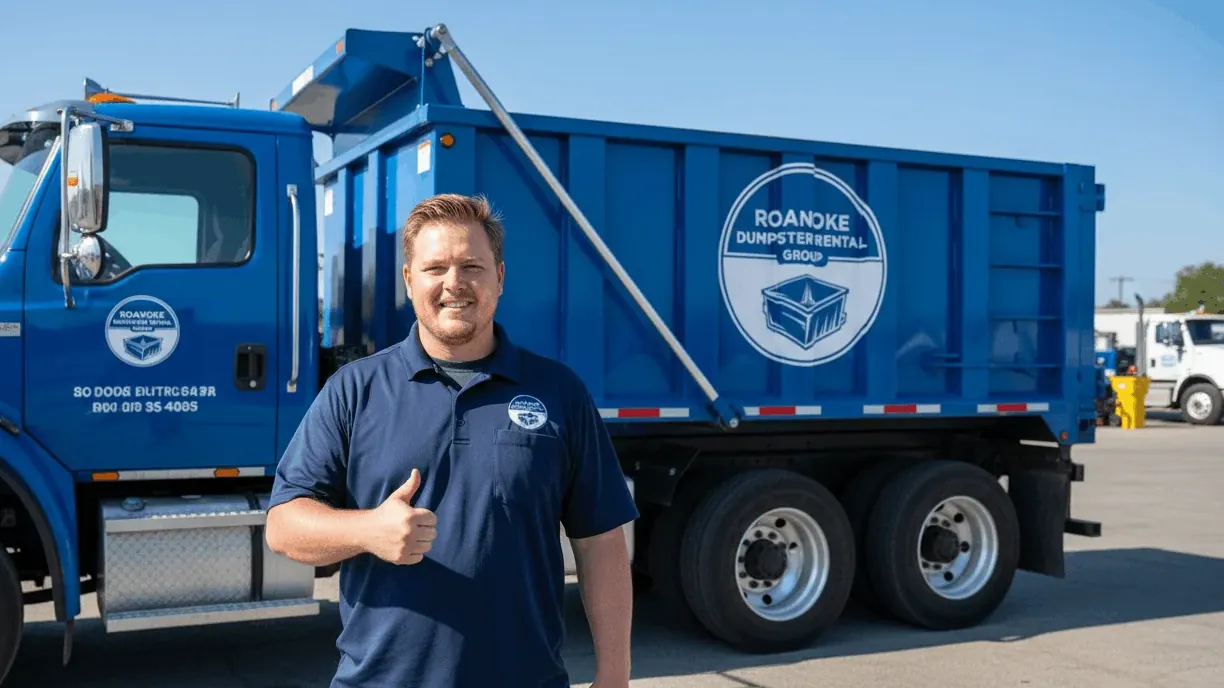
A roll-off container is a steel box on four small contact points, and it arrives on a truck that weighs more loaded than anything else that will ever come up your driveway. Most of the time it goes down, sits there for a week, and comes back off without leaving a mark. When it does leave a mark, it is almost always because nobody looked at the driveway first.
This is how we protect a driveway in the Roanoke Valley, why the terrain here makes it a real question rather than a formality, and when we will tell you the street is the safer place for the box. Call (540) 685-0739 and we will talk through your drive before delivery day.
What the truck actually needs
People imagine a roll-off delivery as a truck pulling up and setting a box down. It is closer to a controlled slide. The container comes off the rails under gravity while the truck creeps forward, and it needs room to do that in a straight line.
| Clearance | What we need | Why |
|---|---|---|
| Straight approach | About 60 feet | The truck has to roll forward while the box slides back |
| Width | About 10 feet 6 inches | Mirrors, rails and a person walking alongside |
| Overhead | 20 feet or more | The hoist arm goes up before the box goes down |
| Set-down pad | Box length plus about 10 feet | Room to pull clear once it is on the ground |
| Combustibles | 5 feet | Fire code clearance from walls, openings and eave lines |
That five-foot number is not ours. Virginia is on the 2021 International Fire Code through the Statewide Fire Prevention Code, effective 18 January 2024, and § 304.3.3 says containers with an individual capacity of 1.5 cubic yards or more shall not be placed within 5 feet of combustible walls, openings or combustible roof eave lines. Every roll-off we deliver, from the 10 to the 40, is far above that threshold. So the rule applies to every box, on every job, without exception.
The 40 needs the most room and the flattest ground
If your drive is short, curved, or on a grade, the 40-yard is usually off the table before we even discuss it. Sizes and footprints are laid out on our dumpster sizes page. On a tight valley driveway the 10 and the 20 do most of the work.
Plywood under every wheel and every rail
This is the single most useful thing anybody does to protect a driveway, and it is not complicated. We lay sheets of plywood where the container rails will sit and where the rear wheels of the truck will bear. Two layers where the grade is steep or the asphalt is soft.
The point is spreading load. A container rail is a narrow steel edge. Under a full box it concentrates thousands of pounds onto a strip a couple of inches wide. Plywood turns that strip into a four-by-eight surface, which is the difference between a driveway that looks the same in a week and one with two parallel grooves in it.
Where it matters most
- Asphalt in July. Roanoke averages a mean annual temperature of 58.1 degrees Fahrenheit and has hit 105, according to National Weather Service Blacksburg climate records for the Roanoke station. Asphalt on a hot afternoon is soft, and steel will print into it.
- Sealcoated drives. A fresh sealcoat is a thin layer that scuffs and drags easily. Tell us if yours was done this season.
- Pavers and stamped concrete. Individual units move. We would rather not set a loaded box on them at all, and will usually suggest an alternative spot.
- Old concrete with cracks already in it. Freeze and thaw has been working on it for years. Plywood spans the weak spots instead of loading them.
- The apron at the street. The transition from street to drive is where trucks bottom out and where concrete cracks. It gets a sheet too.
Steep, curved and hillside-cut driveways
This valley sits on a floor ringed by Mill Mountain, Read Mountain, Tinker Mountain, the Blue Ridge on one side and the Allegheny ridges on the other. Downtown is at about 925 feet and the Roanoke Star sits roughly 846 feet above the city. A lot of housing in South Roanoke, Grandin Court, Deyerle, Crystal Spring, Garden City and Cave Spring was built onto those slopes, and the driveways show it.
Three things change on a grade.
The box lands differently
Gravity is doing the work. On a downhill set the container wants to go faster than the driver wants it to. On an uphill set it may not want to slide at all. A driver who knows the valley reads the grade before backing in and sets accordingly, sometimes from the street rather than up the drive.
The load may not come back up
The winch cable that drags a loaded box back onto the rails has a finite pull. On a steep drive with a heavy load, that math gets tight. This is why we will sometimes put a 10-yard on a hillside job that would take a 20 on flat ground. A smaller box you can actually retrieve beats a bigger box that has to be partly emptied by hand.
The load settles wrong
A container sitting on a slope collects weight at the low end. Load flat and load low. Spread heavy material along the floor of the box rather than piling it at one end, and stop at the fill line. A box that is heavy at the back and light at the front is harder to pull, harder to tarp, and harder on your driveway at the point where the rail bears.
If your driveway is genuinely steep, read our companion piece on steep driveway dumpster delivery in Roanoke before you book.
Karst ground and the point load
Here is a consideration no flat market has to write about. The Roanoke Valley sits in Virginia karst country. Virginia Energy, the state geological survey, describes the Valley and Ridge as an extensive karst terrain underlain by limestone and dolomite, and says plainly that sinkhole collapse, either slow or dramatic, can cause considerable damage to buildings, highways, rails, bridges, pipelines, storm drains and sewers. Roanoke County publishes its own karst areas mapping.
A loaded roll-off is a concentrated point load. A container full of concrete, masonry or wet debris puts several tons onto four small bearing points. On ground where soil may be bridging a void, that is worth a second thought before you decide the box goes in the middle of the lawn or on a soft edge of the drive.
We are not geologists and we are not going to tell you your yard has a void under it. What we will do is keep containers on prepared surfaces, use plywood to spread load, and avoid parking a heavy box over a spot where the ground has been settling, where a fence post leans, or where a depression has been slowly widening. Virginia Energy also notes something worth knowing as a homeowner: subsidence is generally not covered by a standard homeowner insurance policy. Read the state page on Virginia Energy if you want the warning signs list.
Look up before you look down
Overhead is where deliveries fail most often, and it is the easiest thing to check the day before.
- The service drop. The power line from the pole to your house crosses the driveway on a great many valley properties. The hoist arm needs 20 feet or more of clear air. If the drop is low, the box goes somewhere else, or the utility gets called first.
- Mature canopy. Older Roanoke neighborhoods have big street trees and big yard trees. Oaks and maples over a driveway are beautiful and they are also a hard ceiling. A low limb that a car passes under with room to spare will stop a roll-off truck cold.
- Eaves and porch roofs. Not just the fire-code five feet. Any low eave in the swing path of the arm is a problem.
- Basketball hoops, carport beams, cable and telephone drops. All of it counts.
Walk out with your phone, stand where you want the box, and look straight up. If you cannot see open sky above the whole set-down area, call us and describe it.
Weather, seasons and the driveway
Roanoke averages 42.82 inches of precipitation and 14.8 inches of snow a year, on National Weather Service Blacksburg normals for the Roanoke station. That is enough snow to shut a jobsite for a couple of days a winter, not enough to plan a season around. The real winter issue here is not snow depth. It is freeze and thaw.
Repeated cycling across freezing is what spalls concrete, cracks driveways and heaves masonry. A driveway that has been through twenty winters of it is more fragile than it looks. In late winter and early spring, plywood is not optional on older concrete, and we will sometimes ask for a different set-down spot rather than load an area that is already crumbling at the edge.
Wet ground is the other seasonal factor. A soft lawn will not hold a loaded container, and remnants of tropical systems reaching the Blue Ridge can saturate this valley in a day. If it has rained hard, the box goes on pavement or it waits.
When the street is the safer call
Sometimes the honest answer is that your driveway should not take a loaded box. Short drives, sharp turns, decorative surfaces, a low service drop, or a slope that will not let us pull the container back up. In those cases a street placement is the better option, and where you are standing decides how you get one.
The City of Roanoke is an independent city and is not part of Roanoke County. Salem is also independent. Vinton is a town in the county. Four governments in one valley, and they do not answer this the same way.
- In the City of Roanoke there is a real, named Dumpster and Portable Storage Container Permit, issued by the Transportation Division under City Code §§ 14.1-41 through 14.1-46 and § 30-2. The container may sit up to 30 consecutive days. The application goes in at least 10 calendar days before placement. The company has to carry a certificate of public liability insurance of at least $1 million per occurrence naming the City as an additional insured. The box must sit at least 30 feet from stop signs, stop bars, crosswalks and intersections, at least 5 feet from driveways, and must leave a 10-foot travel lane. Traffic cones and reflective tape must be in place at all times. The City does not publish a fee, so contact the Transportation Division for current amounts.
- In Roanoke County the residential street out front is usually maintained by VDOT, the state, under the Byrd Road Act. So a street placement in a county subdivision is a VDOT question rather than a county one. Call the VDOT Salem District before you plan one.
- In Salem and Vinton contact the locality directly. Each runs its own system.
We carry the insurance the City requires and we file the paperwork on time. The permit side is covered in more detail in our guide to dumpster permits in Roanoke, and the container itself is described on our roll-off dumpster rental page.
A short checklist for delivery day
- Clear the driveway completely. Cars, trailers, trash carts, basketball hoops, planters.
- Mark exactly where you want the box, with a stake or a bucket. Drivers follow marks.
- Look straight up. Note anything crossing the set-down area or the approach.
- Tell us the surface. Asphalt, concrete, gravel, pavers, or grass, and how old it is.
- Tell us the grade. If you have to use the parking brake to walk down it, say so.
- Keep 5 feet from the house, the eaves and anything combustible.
- Have somebody home for the first delivery if the placement is at all tricky.
- Once loading starts, load flat and low, heavy material on the floor, nothing above the rim.
None of this takes long, and it is the difference between a clean job and a repair bill. If you are not sure your drive will take a container, call (540) 685-0739 and describe it. We would rather look at the problem before delivery than after.
Questions this guide did not answer? Call (540) 685-0739. We would rather spend two minutes on the phone than have you order the wrong container.