
Cave Spring, VA · Roanoke County
Dumpster Rental in Cave Spring, VA
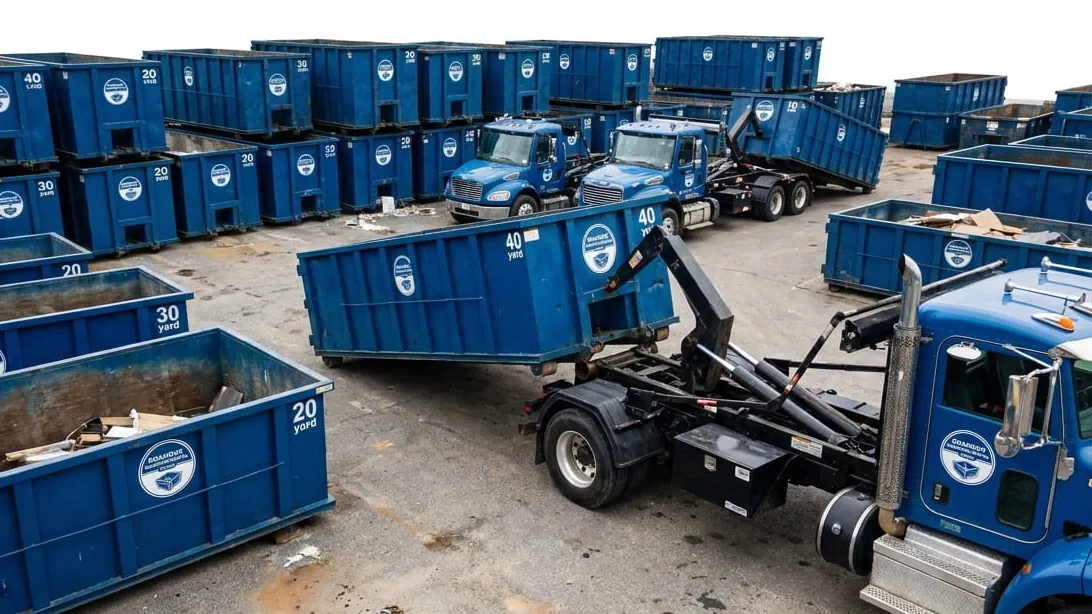
Roll-off containers delivered to Cave Spring from our Roanoke yard — about 8 miles south-west of our Peters Creek Road yard. Flat rates, driveway protection as standard, and same-day delivery when we can get a truck free.
Roll-off containers for Cave Spring homes and jobsites
Cave Spring is the south-west corner of Roanoke County and the recognized name for the whole 24018 side of the valley. It is county, not city, and in Virginia that distinction changes more than people expect. Roanoke County is a separate government from the City of Roanoke, which is an independent city and is not inside the county at all. Cross the line between them and the permit authority changes, the frost depth changes, the trash rules change, and so does the answer to the question of who owns the pavement out front. That last one is the big one, and it is the reason this page reads differently from the city pages on this site.
Roanoke County’s residential streets are maintained by VDOT, the state, under the Byrd Road Act of February 1932. Only Arlington and Henrico opted out, and only five states in the country run their local roads this way at all. What that means in practice is simple to say and easy to get wrong. The street out front of a Cave Spring house is the state’s, not the county’s, so a street placement is a VDOT Salem District question rather than a county one. Call them first. On your own driveway, none of it applies, and that is where the overwhelming majority of Cave Spring containers go anyway, because this is subdivision country with wide lots, deep setbacks and front-loaded garages.
The demographics explain the work. Roanoke County has 97,150 people spread across 250.55 square miles at 386.9 per square mile, against the City of Roanoke’s 99,111 people packed into 42.52 square miles at 2,352 per square mile. Nearly identical populations, and the county is almost six times the area. County housing is newer and worth more, with a median value of $286,000 against the city’s $190,500, and the county is 75.7 percent owner-occupied against the city’s 52.4 percent. The city work is landlord turnovers and cleanouts. The county work, and Cave Spring is the heart of it, is owner-occupied renovation: kitchens, baths, basements, decks, roofs and whole-house remodels in houses their owners intend to keep.
Two things about the terrain. First, the western and southern edges of Cave Spring run up against Poor Mountain and Bent Mountain, and hillside lots there produce short, steep, curved driveways where a smaller box loaded flat is the right answer. Second, the ground is karst, the soluble carbonate rock that gives this valley its caves and springs and, occasionally, its sinkholes. Virginia Energy points out that subsidence is generally not covered by a standard homeowner’s insurance policy. A loaded 30 yard container is a point load, so we care where it sits and not only whether it fits. Frost depth in Roanoke County is 24 inches, against 18 in the City of Roanoke, and that is a number that only means anything when it is attached to a named locality. Termite infestation probability is rated SEVERE here as it is across the valley, so crawlspace framing repair is a regular job, and it produces a small volume of very heavy debris. Roanoke gets 14.8 inches of snow in an average year on the 1991 to 2020 normals published by NWS Blacksburg, which costs a jobsite a couple of days a winter rather than a season. Call (540) 685-0739 and we will size the box before we quote it.
What we know about working in Cave Spring
Cave Spring is in Roanoke County, and the county answers differ from the City of Roanoke’s in three ways worth knowing before you book. The first is the street. Under the Byrd Road Act, which dates to February 1932, VDOT maintains the county’s residential streets, so the pavement in front of a Cave Spring house belongs to the state rather than to Roanoke County. A street placement is therefore a VDOT Salem District question, and you should call them before you plan one. We will not tell you that a VDOT permit is required for a residential container, because VDOT does not publish a dumpster category in its land use permit regulation at 24VAC30-151 and we are not going to invent one. What the regulation does say, at 24VAC30-151-50, is that objects placed on, above or under the right-of-way in violation of the general rules must be removed within 10 calendar days of notice from VDOT, and immediately if they pose an immediate safety risk. On your own driveway, none of this is in play. That is where nearly every container in this part of the county goes. The second difference is collection. Roanoke County states that small amounts of debris from homeowner-generated small remodeling or repair work may be put out with bulk pickup, which is precisely the opposite of the City of Roanoke, whose solid waste program under City Code Chapter 14.1 does not collect construction and demolition debris and excludes homeowner remodeling material outright. The county will not take bricks, concrete, dirt, sod, rocks, metal or hot ashes. The point of a container here is volume and weight, not that the county refuses everything. The third is the numbers. Frost depth in Roanoke County, and in Vinton and Salem, is 24 inches; in the City of Roanoke it is 18. Termite infestation probability is rated SEVERE for the county as it is for the city. Fire clearance is five feet, from section 304.3.3 of the 2021 International Fire Code as adopted in Virginia at 13VAC5-51 effective 18 January 2024, at a 1.5 cubic yard threshold that every roll-off exceeds. Before you dig or demolish, call Virginia 811, still known as Miss Utility, giving not less than 48 hours nor more than 12 working days under Va. Code section 56-265.19 A. Demolition is expressly covered. For sorting a renovation load properly, read our guide to construction debris disposal in Virginia.
- RegionRoanoke County
- Distance from our yard8 miles south-west of our Peters Creek Road yard
- Main routesPeters Creek Road south to Brandon Avenue, west to VA-419 Electric Road, then south to Cave Spring Corners
- Typical deliverySame or next day
Getting a truck to you
The standard run is Peters Creek Road south to Brandon Avenue, west to Electric Road and then south into Cave Spring, which is a straightforward twenty-five minutes outside of the afternoon peak. Electric Road carries us the length of the western county, Brambleton Avenue is the approach from the city line, and Starkey Road and Buck Mountain Road serve the southern edge. When Brandon backs up we drop I-581 to Franklin Road and cut west instead. Most Cave Spring placements are on private driveways, which keeps the paperwork out of it, so what we want to know is the drive itself: width at the narrowest point, surface, slope, the length of straight run behind the container, and what is overhead. A 20 yard box wants about sixty feet of approach and twenty-three feet of vertical clearance. On the hillside lots toward Poor Mountain and Bent Mountain we may recommend a smaller container and a second haul instead.
Routes we run: Peters Creek Road south to Brandon Avenue, west to VA-419 Electric Road, then south to Cave Spring Corners, VA-419 Electric Road south from the Salem side for the whole western half, US-221 Brambleton Avenue south-west from the city line, I-581 south to Franklin Road, then west on VA-419 when the surface streets are slow, Starkey Road and Buck Mountain Road for the streets on the southern edge.
Landmarks and neighborhoods we work around
Local landmarks
- Cave Spring Corners at VA-419 and US-221
- the VA-419 Electric Road commercial arc
- Poor Mountain rising on the western edge
- Hunting Hills to the east
- Green Ridge and the Brambleton Avenue corridor
- Bent Mountain and the climb south on US-221
Neighborhoods & communities
- Penn Forest to the east
- Oak Grove to the north
- Hunting Hills
- Poages Mill to the south-west
- Back Creek to the south
- the Starkey Road corridor
Permits, streets and placement in Cave Spring
Start with the question nobody has to ask in a normal county: which government are you standing in. The Roanoke Valley runs four of them at once. The City of Roanoke is an independent city and is not part of Roanoke County. Salem is a second independent city. Vinton is a town, and the town is in the county. Roanoke County keeps its own courthouse at 305 E. Main St in Salem, which tells you most of what you need to know about how the lines here were drawn. Virginia is also a Dillon Rule state, so a locality holds “only those powers which are expressly granted” — no office in this valley can invent a container rule the General Assembly never enabled, and none of the four has to answer the same way its neighbor does. Work out which one covers the address in Cave Spring before you plan anything in the street, because the street is where the answers split. In the City of Roanoke the pavement is the City’s, and a container in it needs the City of Roanoke Dumpster/Portable Storage Container Permit, issued by the Transportation Division of Public Works under City Code §§ 14.1-41 through 14.1-46 and § 30-2. The numbers are worth carrying in your head: 30 consecutive days maximum for a dumpster, 7 days for a portable storage container, the application in at least 10 calendar days ahead of placement, and a certificate of public liability insurance of at least $1 million per occurrence naming the City of Roanoke as an additional insured. Placement is 30 feet clear of stop signs, stop bars, crosswalks and intersections, 5 feet clear of driveways, never blocking a walkway or a fire hydrant, with a 10-foot travel lane kept open and “traffic cones and reflective tape in place at all times.” Company contact information goes on at least two sides, and the applicant notifies the adjacent businesses and residences. The City does not publish the fee, so ask the Transportation Division for the current amount rather than trusting a number off a web page, ours included. In Roanoke County the pavement out front is usually not the county’s at all. Under the Byrd Road Act of February 1932, VDOT maintains the secondary roads — only Arlington and Henrico opted out, and only five states run their roads this way — so a street placement out there is a VDOT question, and the call goes to the VDOT Salem District before you plan it. We will not tell you there is a VDOT dumpster permit, because 24VAC30-151-30 does not list one. What the regulation does say, at 24VAC30-151-50, is that objects placed in the right-of-way in violation of the rules must be removed within 10 calendar days of receipt of notice from VDOT, and immediately, at the owner’s expense, if they are an immediate safety risk. Salem runs its own arrangements and Vinton runs a fourth; call the town or the city directly. On your own driveway, none of that applies, which is why the driveway is nearly always the right answer in Cave Spring. The driveway carries one rule of its own and it is a fire rule. Virginia is on the Statewide Fire Prevention Code at 13VAC5-51, which adopts the 2021 International Fire Code, and § 304.3.3 sets the trigger at 1.5 cubic yards and the clearance at five feet from combustible walls, openings and combustible roof eave lines. Every roll-off we own is over that threshold, so five feet is simply how we set them: off the siding, off the soffit line, clear of doors, windows, exits, fire apparatus access and hydrants, and no flammable or combustible liquids in the box. There is no state fire permit for an individual container. Last, the approach. To swing a box off the rails we want about 60 feet of straight, roughly 10.5 feet of width and 20-plus feet of clear overhead. What fails that test in Cave Spring is almost never the ground. It is the mature tree canopy with the electrical service drop running underneath it — a spot that looks wide open at eye level can be closed at twenty feet. Walk out and look up before you call, and tell us what you see.
Two more layers reach every job we run, and both come from Richmond rather than from a local counter. The first is what may legally go in the box. Virginia’s solid waste regulation is 9VAC20-81, administered by Virginia DEQ, and it regulates facilities rather than materials — there is no long banned-items list here to memorize, whatever other dumpster pages tell you. The one real statewide disposal ban is lead-acid batteries, Va. Code § 10.1-1425.1, where each battery is a separate violation. Waste tires run on a threshold rule rather than a flat ban. Beyond that, be careful what you read on other dumpster pages: there is no electronics disposal ban in Virginia, and the Computer Recovery and Recycling Act is a manufacturer take-back law rather than a landfill prohibition. Leftover paint has no producer-funded drop-off program in this state either, so it has to be dealt with the hard way. None of that makes everything welcome in our containers. Paint, solvents, fuel, automotive fluids, batteries and pool chemicals stay out and take the household hazardous waste route instead. Asbestos is the hard stop. We do not accept asbestos in our containers. In Virginia an asbestos project runs through a DPOR-licensed contractor with DOLI notification, and the waste goes to a facility permitted to take it under 9VAC20-81. Three agencies: licensing at DPOR, notification and permits at DOLI, disposal at DEQ. Two dates decide whether that lands on your job before a building permit is even issued. Under Va. Code § 36-99.7 a locality may not issue a building permit for renovation or demolition of a building whose initial building permit predates 1 January 1985 without a licensed asbestos inspection, and the exemption is narrow and specific: residential buildings of four units or fewer are exempt unless the work is for commercial or public development. Read that twice before assuming a house is out of it. Separately, DOLI must be notified 10 working days before ANY demolition, asbestos or not. The second date is 1 January 1978, which puts a project under the federal EPA RRP rule for lead-safe work practices; in Virginia the RRP rule is EPA-administered rather than state-run, and window replacement and demolition are covered regardless of square footage. Roanoke has no local lead ordinance, so the federal rule is the whole of it. Then, before anything is dug, trenched, driven or pulled — and before anything is knocked down, because demolition is expressly covered — call Virginia 811 on 811. Most people here still call it Miss Utility. Va. Code § 56-265.19 A sets the window at “not less than 48 hours nor more than 12 working days,” so that call goes in the week before, not the morning of. Our permit and placement guide walks the whole sequence, and the solid waste chapter, the right-of-way permit and the collection limits are all published by the City of Roanoke and by Roanoke County.
The ground under Cave Spring decides most of the rest. Frost depth in this valley is published as two numbers, not one: 18 inches in the City of Roanoke, and 24 inches in Roanoke County, Vinton and Salem. Which one governs a footing depends on which locality the address sits in, which is why we name the locality every time we print the number. All four are rated SEVERE for termite infestation probability, and that rating, plus a crawlspace-heavy housing stock and humid summers, produces the signature job in this market: sill plate, band joist and subfloor replacement. Crawlspaces are common here, and plenty of older city houses have basements, so a cleanout can start below grade in either direction. Termite and rot debris is short, wet and heavy, and it is the commonest reason a container goes over payload while it still looks half full — on that work we would rather send a 10 yard twice than a 30 yard once. The rock underneath is soluble carbonate: this is Virginia’s karst belt, with caves, springs and sinkholes, and Virginia Energy puts the consequence plainly, warning that subsidence “is generally not covered by a standard homeowner’s insurance policy.” A loaded box is a concentrated point load on soil that may be bridging a void. That is a real reason to care where it goes, not a line of sales copy. The other terrain problem is slope. Between Mill Mountain, Read Mountain, Tinker Mountain, the Blue Ridge and the Allegheny ridges, a fair share of the driveways we back down are steep, curved or cut into a hillside. That changes whether a box will stay where it is set, whether the truck can get it off the rails at all, and whether the cable can pull it back up loaded. Load flat, load low. Plywood goes under every wheel and under both rails, on every placement, all year. The weather is the part outsiders get backwards in both directions. The 1991–2020 normals for station ROA, published by the National Weather Service office in Blacksburg, are 14.8 inches of snow, 42.82 inches of precipitation and a mean annual temperature of 58.1°F. It does snow here. It just does not snow enough to plan a season around: enough to shut a jobsite for a couple of days a winter, and the code agrees, with a ground snow load of 30 psf and ice barrier underlayment not required. Elevation changes that inside our service area, and the design figures from the higher ground west of the valley are not this valley’s figures. The real seasonal drivers are the remnants of tropical systems climbing the Blue Ridge, ice storms and freeze–thaw. And water. In November 1985 the Roanoke River crested at 23.35 feet against a 10-foot flood stage on 6.61 inches of rain in 24 hours, at least ten people in the valley died, and the answer was the USACE Roanoke River Flood Reduction Project. Anybody who was here remembers it, and it is why a soaked crawlspace or a flooded basement is an ordinary call for us rather than an unusual one. Where the load ends up is the local detail we like best. The Roanoke Valley Resource Authority takes the valley’s waste to the Tinker Creek Transfer Station and then moves it 33 miles by Norfolk Southern rail to the Smith Gap Landfill. In the city that built the Norfolk and Western, the garbage still goes by train. Household hazardous waste is appointment and event based through the RVRA rather than curbside, so plan around a date instead of setting it out. And the collection answers split the way everything else here splits: the City of Roanoke, under City Code Chapter 14.1, runs bulk and brush collection with limits and explicitly does not collect construction and demolition debris, while Roanoke County will take small amounts of homeowner remodeling debris with bulk collection. Salem runs a third system and Vinton a fourth. Four governments, four answers, and the line where a roll-off starts sits in a different place in each of them.
Sizes we deliver to Cave Spring
10 Yard Dumpster
Concrete, block, brick and termite-rotted framing — and the box that fits a steep or narrow drive.
View this size → 15yd³15 Yard Dumpster
A single room, a small tear-off, or one unit of a city rental turnover.
View this size → 20yd³20 Yard Dumpster
A crawlspace and attic clear-out — the Roanoke default — or a multi-room remodel.
View this size → 30yd³30 Yard Dumpster
A whole-house cleanout or a large county remodel, where there is room to set it.
View this size → 40yd³40 Yard Dumpster
Commercial gut jobs and construction — it needs the most room and the flattest ground.
View this size →Delivering to Cave Spring today
Call before about 11am and we can usually get a container to Cave Spring the same afternoon.
(540) 685-0739Nearby towns
Popular in Cave Spring
Services in Cave Spring
What we haul in and out of Cave Spring
Residential Dumpster Rental
Driveway placement for the crawlspace, attic and basement cleanouts an older valley house produces.
Learn more →Junk Removal Dumpsters
Clear a crawlspace, attic, garage or basement on your own schedule.
Learn more →Roofing Dumpster Rental
Weight-rated cans sized by squares and layers, set five feet off the eave line.
Learn more →Construction Dumpster Rental
Mixed C&D in one roll-off, with next-day swap-outs across the Roanoke Valley.
Learn more →Yard Waste & Brush Removal
Separate clean loads for brush and clearance beyond what curbside will take.
Learn more →Estate Cleanout Dumpsters
Discreet, patient container service for families clearing a lifelong home.
Learn more →How it works
Delivering to Cave Spring in four steps
- 1
Call us
Tell us the project, your address and when you want it. Two minutes on the phone and you have a flat price.
- 2
We deliver
Our driver walks the drop, lays protection boards and sets the container exactly where you want it.
- 3
You load it
Take your time within your rental window. Keep it level with the top rail and we handle the rest.
- 4
We haul it
Call or text when you are done. We pull it, sort what can be recovered and dispose of the rest properly.
Dumpster Rental in Cave Spring — FAQs
Do I need a permit for a dumpster in Cave Spring?
Not on your own driveway, which is where nearly all of them go here. A street placement is a different matter, and the reason is unusual. Under the Byrd Road Act, VDOT maintains Roanoke County residential streets, so the pavement out front is the state’s rather than the county’s and a street placement is a VDOT Salem District question. Call them before you plan one. We will not claim a specific VDOT dumpster permit exists, because the land use permit regulation at 24VAC30-151 does not list one. What it does say, at 24VAC30-151-50, is that objects in the right-of-way must come out within 10 calendar days of notice.
Will Roanoke County collect my remodeling debris at the curb?
Small amounts, yes, and that is the opposite of the City of Roanoke. Roanoke County states that small amounts of debris from homeowner-generated small remodeling or repair work may be placed out with bulk pickup rather than in the regular container. The City of Roanoke does not collect construction and demolition debris at all and excludes homeowner remodeling material outright. Same valley, adjacent governments, opposite answers to the same question. The county still will not take bricks, concrete, dirt, sod, rocks, metal or hot ashes. Once the job is bigger than a small amount, which is most kitchen or bath projects, a container is the practical route.
What is the frost depth in Cave Spring for a footing?
Twenty-four inches, because Cave Spring is in Roanoke County. The City of Roanoke uses 18 inches, so the number changes as you cross the line into the city. Roanoke County, the Town of Vinton and the City of Salem all use 24. It comes up on dumpster jobs more than you might expect, because a deck rebuild or a porch replacement that fills a container also involves new piers. Confirm it with the building official for the locality your address actually sits in, and call Virginia 811 before you put a shovel in the ground. Notice is not less than 48 hours nor more than 12 working days.
Why is a Cave Spring job different from one in the city?
Scale and tenure, mostly. Roanoke County holds 97,150 people across 250.55 square miles at 386.9 per square mile, while the City of Roanoke holds 99,111 across 42.52 square miles at 2,352. Nearly the same population, almost six times the area. County housing is newer and worth more, with a median value of $286,000 against $190,500 in the city, and the county is 75.7 percent owner-occupied against 52.4 percent. So county work tends to be owner-occupied renovation with room to place a box, and city work tends to be turnovers and cleanouts on tighter lots.
Does sinkhole risk affect where a container sits here?
It is worth considering. The Roanoke Valley sits in Virginia’s karst belt, soluble carbonate rock that produces the caves and springs the area is named for and, occasionally, sinkholes. Virginia Energy notes that subsidence is generally not covered by a standard homeowner’s insurance policy. A loaded 30 yard container is a concentrated point load on soil that may be bridging a void. We are not forecasting a collapse for your driveway. We are saying that a heavy box belongs on solid, well-drained original ground rather than on fill, a soft shoulder or a patch that has settled before, and that costs nothing to plan for.
How quickly can you deliver a dumpster to Cave Spring?
Cave Spring is about 8 miles south-west of our Peters Creek Road yard, so it is a routine run for us. Same-day delivery is usually possible if you call before about 11am, and next morning otherwise. An ice storm or a hard freeze can stretch that, and so can the week after the remnants of a tropical system come over the Blue Ridge and half the valley opens a wet crawlspace at once. We will tell you honestly when you call.
Do you charge extra to deliver to Cave Spring?
No. Cave Spring sits inside our standard service area and the flat rate is the same as it is in Roanoke. Delivery, pickup, your rental window and disposal up to the agreed tonnage are all included in the number we quote you.
What size dumpster do most Cave Spring customers take?
A 20 yard is the most common by a wide margin — it suits kitchen guts, multi-room renovations and a crawlspace-and-attic clear-out, which is where most of the volume in this market actually lives. But if you are stripping shingle off a roof, breaking out a front walk or a patio slab, or hauling out rotten sill plate, band joist and subfloor off a termite repair, size DOWN to a 10 yard heavy container and take two hauls — that material hits the weight limit long before it fills the box.
Nearby
Towns we serve around Cave Spring
Talk to a real person
Need a dumpster in Cave Spring?
Tell us the job and the address and we will size it, price it flat and get a truck out. We run to Cave Spring most days, so a same-day slot is often available.
Cave Spring, VA · Roanoke County · delivered from 3783 Peters Creek Rd, Roanoke, VA 24018