
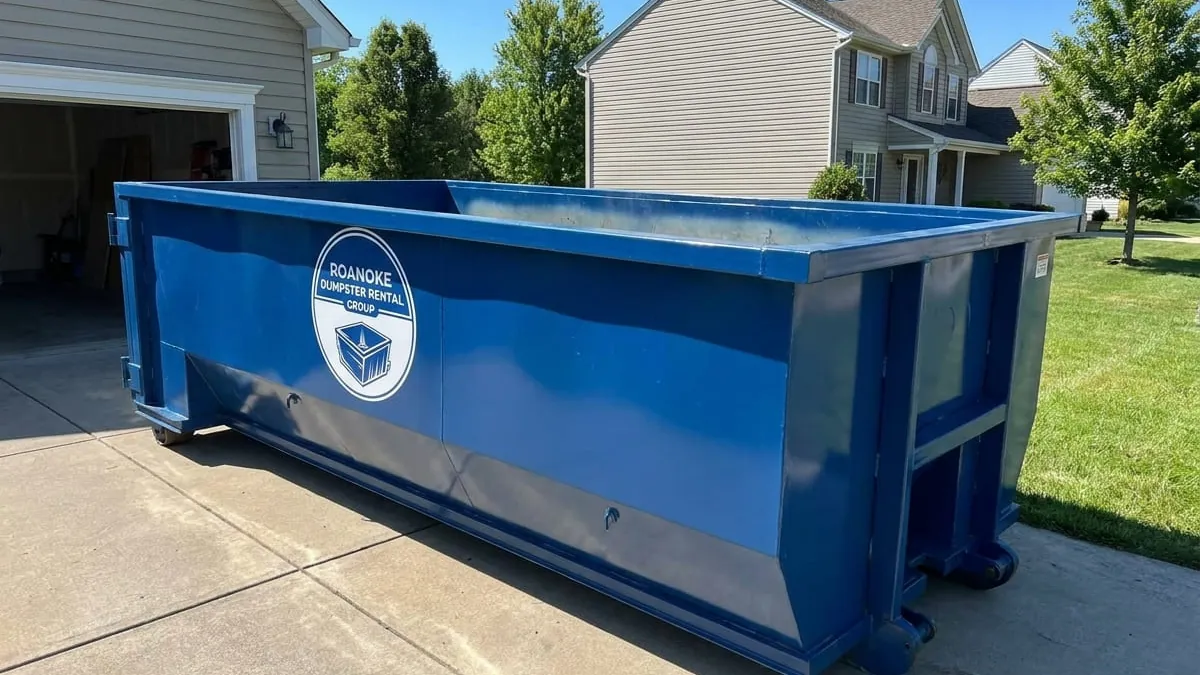
Roanoke, VA · the Roanoke Valley
Dumpster Rental in Roanoke, VA — Delivered Fast, Priced Flat
10 through 40 yard roll-off dumpsters for homeowners, contractors and businesses across Roanoke and Southwest Virginia. One phone call, one flat price, and a driver who protects your driveway. Locally owned since 2012.
- Same-day & next-day delivery
- Flat rates that include disposal
- Driveway protection boards as standard
- Licensed, insured and locally owned
Licensed & insured · Flat-rate quotes · Locally owned since 2012
Why Roanoke Dumpster Rental Group
The dumpster company Roanoke calls back
Most people renting a dumpster are already having a stressful week. The kitchen is in pieces, the roof is half off, or a family member has passed and there is a house full of forty years to sort out. The last thing anyone needs is a hauler who quotes one price, invoices another, and drops a container across the mailbox.
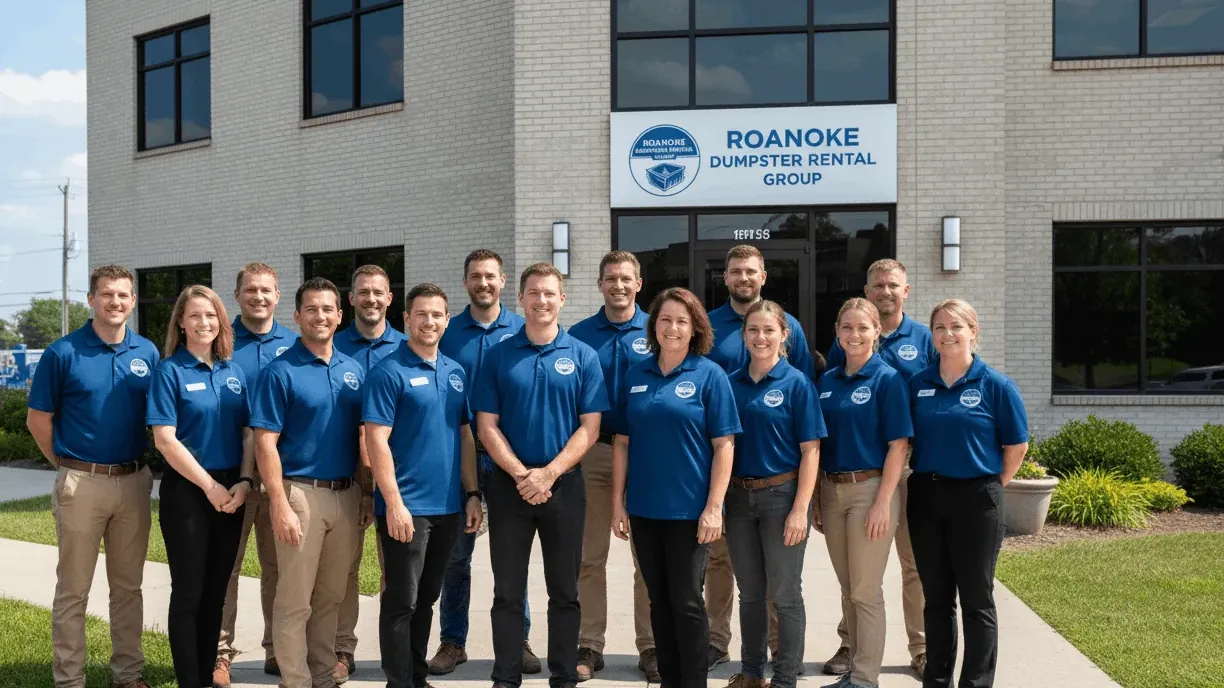
We started Roanoke Dumpster Rental Group in 2012 with one truck and one rule: tell people the truth about what it costs and show up when we said we would. 14 years later that has not changed. Wade Hollins still answers the phone most mornings, and our drivers still walk the drop before they back in.
We run out of 3783 Peters Creek Rd, with I-81, I-581, US-220, US-460, US-11 and VA-419 close enough that we cover the whole valley every day rather than routing a truck in from another market when you need a container this afternoon. It also means we know the rulebooks apart, and in this valley that is most of the job. The City of Roanoke is an independent city and it is not part of Roanoke County. Neither is Salem. Vinton is a town, and a town in Virginia sits inside its county, so Vinton is in Roanoke County. If you want that in one checkable line: Roanoke County’s courthouse is at 305 E. Main Street in Salem, a separate, independent city. So there are four governments in one valley — the City of Roanoke, Roanoke County, the City of Salem and the Town of Vinton — and they give four different answers to the same question. Virginia is also a Dillon Rule state, which means a locality holds only those powers expressly granted to it, so nobody here gets to invent a rule and nobody here gets to waive one. Two of those answers land directly on your driveway. The City of Roanoke does not collect construction and demolition debris: its solid waste program under City Code Chapter 14.1 excludes contractor waste, homeowner-generated remodeling materials, land-clearing debris, rocks, dirt, brick and concrete, and stumps, and it caps bulk at three items a week with a brush pile no bigger than six feet each way. Roanoke County, four miles away, will take small amounts of homeowner remodeling debris with its biweekly bulk collection. Same valley, opposite answers, and knowing which one applies to your address is most of what a dumpster company is for. Where the material actually goes is worth knowing too: the Roanoke Valley Resource Authority runs the Tinker Creek Transfer Station and then moves the valley’s waste 33 miles by Norfolk Southern rail to the Smith Gap Landfill. In the city the railroad built, the garbage still leaves by train. Over the top of all of it sits the Virginia Statewide Fire Prevention Code, 13VAC5-51, which adopted the 2021 International Fire Code effective 18 January 2024. The part that matters on a driveway is § 304.3.3: a container of 1.5 cubic yards or more must not be stored in a building or placed within five feet of combustible walls, openings or combustible roof eave lines. Every roll-off we own is far above 1.5 cubic yards, so five feet applies to every box we drop, every time. Past the codes it is street knowledge: which hillside drives in South Roanoke, Grandin Court, Deyerle and Cave Spring are too steep or too tightly curved to set a loaded box on; which blocks in Old Southwest, Gainsboro and Belmont have a narrow street and a rear alley, so the box goes at the head of the drive before a car boxes it in; which lots sit on karst ground, where a loaded container is a point load on soil that may be bridging a void; which crawlspace jobs in Wasena and Raleigh Court come out as rotten sill plate rather than furniture; and which addresses are actually Salem or Vinton and answer to a different desk entirely.
Read more about who we are and how we got started, or jump straight to what we haul.
- Founded2012
- Container sizes10 – 40 yd³
- Typical deliverySame or next day
- Areas served18+
What we haul
Dumpster rental services in Roanoke and Southwest Virginia
Eleven container services, one flat-rate promise. Whatever the job, the price we quote on the phone is the price on your invoice.
Residential Dumpster Rental
Driveway placement for the crawlspace, attic and basement cleanouts an older valley house produces.
Learn more →Commercial Dumpster Rental
Containers for businesses and contractors — the City of Roanoke does not collect construction debris.
Learn more →Construction Dumpster Rental
Mixed C&D in one roll-off, with next-day swap-outs across the Roanoke Valley.
Learn more →Roofing Dumpster Rental
Weight-rated cans sized by squares and layers, set five feet off the eave line.
Learn more →Roll-Off Dumpster Rental
10, 15, 20, 30 and 40 yard roll-offs across Roanoke, the county, Salem and Vinton.
Learn more →Same-Day Dumpster Rental
Call before the cut-off and we can usually get a container to you this afternoon.
Learn more →Junk Removal Dumpsters
Clear a crawlspace, attic, garage or basement on your own schedule.
Learn more →Estate Cleanout Dumpsters
Discreet, patient container service for families clearing a lifelong home.
Learn more →Demolition Debris Removal
Containers and fast swaps for porches, decks, sheds, garages and interior gut-outs.
Learn more →Concrete & Heavy Debris
Dedicated heavy cans for concrete, block, brick and rubble on karst ground.
Learn more →Yard Waste & Brush Removal
Separate clean loads for brush and clearance beyond what curbside will take.
Learn more →Choose your size
Five sizes, sized for real projects
Not sure which one? Tell us what you are clearing out and roughly how much of it there is. Ninety percent of the time we can size it correctly over the phone in under two minutes. The first question here is what the debris weighs rather than how much room it takes, because termite-damaged sill plate, band joist and subfloor off a crawlspace repair, broken concrete and brick out of a footing or a chimney, spoil from a dig taken to 18 inches in the City of Roanoke or 24 inches in Roanoke County, Vinton and Salem, and an asphalt shingle tear-off counted in squares and layers are all weight jobs long before they are volume jobs. Wet framing and masonry are the commonest reason a container here goes over payload while it still looks half full. Dense material like broken concrete, brick, block, pavers and excavation spoil wants a small can, and on a steep drive it is the only can that makes sense. A deck or porch tear-off, or a whole-house clearout with the crawlspace, the attic and the garage in it — framing lumber, cabinets, insulation and trim — is the job that genuinely wants a 40, because that debris takes up enormous space and weighs comparatively little. Bear in mind that an open can catches every storm, and Roanoke averages 42.82 inches of precipitation a year against 14.8 inches of snow, on the 1991 to 2020 normals for station ROA published by NWS Blacksburg. Water sitting in an open container is weight you pay to haul. Keep the load below the rails where it can be covered.
10 Yard Dumpster
Concrete, block, brick and termite-rotted framing — and the box that fits a steep or narrow drive.
View this size → 15yd³15 Yard Dumpster
A single room, a small tear-off, or one unit of a city rental turnover.
View this size → 20yd³20 Yard Dumpster
A crawlspace and attic clear-out — the Roanoke default — or a multi-room remodel.
View this size → 30yd³30 Yard Dumpster
A whole-house cleanout or a large county remodel, where there is room to set it.
View this size → 40yd³40 Yard Dumpster
Commercial gut jobs and construction — it needs the most room and the flattest ground.
View this size →How it works
Four steps, no paperwork
- 1
Call us
Tell us the project, your address and when you want it. Two minutes on the phone and you have a flat price.
- 2
We deliver
Our driver walks the drop, lays protection boards and sets the container exactly where you want it.
- 3
You load it
Take your time within your rental window. Keep it level with the top rail and we handle the rest.
- 4
We haul it
Call or text when you are done. We pull it, sort what can be recovered and dispose of the rest properly.
Local knowledge
What makes hauling in Roanoke different
Hillside drives, karst ground, and three answers to one permit question
Placement is where most of the trouble starts here, and it is rarely about the size of the box. The valley floor sits around 925 feet with Mill Mountain, Read Mountain, Tinker Mountain, Poor Mountain and Fort Lewis Mountain around it, the Blue Ridge to the southeast and the Allegheny ridges to the northwest. Mill Mountain alone rises to 1,703 feet and the Roanoke Star on top of it stands 846 feet above the city. That geography puts a real share of local driveways on a grade: short, steep, tightly curved, or cut into a hillside in South Roanoke, Grandin Court, Deyerle, Crystal Spring, Garden City and out through Cave Spring. A roll-off delivery is a gravity operation — the box slides off the rails — and on a grade that behavior changes, along with whether the cable can pull a loaded box back up. The answer is usually a smaller box, loaded flat and loaded low, and occasionally it is the street instead. The ground is the other half of it. The Roanoke Valley sits in Virginia’s karst belt, soluble carbonate rock with caves, springs and sinkholes, and Roanoke County maps its own karst areas. Virginia Energy puts the consequence bluntly: subsidence “is generally not covered by a standard homeowner’s insurance policy.” A loaded container is several tons on four small contact patches, sitting on soil that may be bridging a void, which is a genuine reason to care where the box goes rather than a sales line. Older streets add their own limits: Old Southwest, Gainsboro and Belmont have narrow frontages and rear alleys. Figure on roughly 60 ft of straight approach, 10.5 ft of width and 20+ ft of clear sky for the hoist arm wherever you are.
Then the rules national guides get wrong for this state. The clearance first: Virginia is on the Statewide Fire Prevention Code, 13VAC5-51, which adopted the 2021 International Fire Code effective 18 January 2024, so the container rule is § 304.3.3 — a container of 1.5 cubic yards or more must not be stored in a building or placed within five feet of combustible walls, openings or combustible roof eave lines. Every roll-off is far over that threshold, so five feet applies to every box, and there is no state fire permit for an individual container. The permit is where the valley splits three ways. On a City of Roanoke street, alley or sidewalk you need the City’s own Dumpster/Portable Storage Container Permit, issued by the Transportation Division of the Department of Public Works under the Code of the City of Roanoke (1979), §§ 14.1-41 through 14.1-46 and § 30-2. It runs a maximum of 30 consecutive days for a dumpster and 7 for a portable storage container, it has to be applied for at least 10 calendar days ahead, and it requires a certificate of public liability insurance of at least $1 million per occurrence naming the City of Roanoke as additional insured. The placement conditions are specific: at least 30 feet from stop signs, stop bars, crosswalks and intersections, at least 5 feet from driveways, no blocking walkways or fire hydrants, a 10-foot travel lane kept open at all times, traffic cones and reflective tape in place at all times, company contact information on at least two sides, and the applicant has to notify adjacent businesses and residences. The City does not publish the fee, so ask the Transportation Division for the current schedule rather than trusting a number online. That $1 million and ten-day paperwork requirement is also a fair filter: it is not a form a one-truck outfit fills in. On a Roanoke County subdivision street the road out front is usually the state’s, not the county’s, under the Byrd Road Act of February 1932 — only Arlington and Henrico opted out, and only five states run local roads this way at all. That makes a county street placement a VDOT Salem District question, and the honest advice is to call them before you plan one. Be wary of anyone who quotes you a VDOT dumpster permit: 24VAC30-151-30 contains no such category. What does exist is 24VAC30-151-50, under which objects placed on the right-of-way in violation of the rules must be removed within 10 calendar days of notice. On a private driveway, normally no permit at all. Before anything gets dug or knocked down — footings, a fence line, a stump, a porch, a shed — call Virginia 811 on 811, the state one-call center most people here still call Miss Utility. Va. Code § 56-265.19 A sets the window at “not less than 48 hours nor more than 12 working days” from the locate request, the ticket is good for 15 working days, and demolition is expressly covered, not just digging. Tell us the cross streets and we will tell you where the can goes, or read the permit and placement guide.
Crawlspaces, severe termite pressure, and the three dates that decide the job
The City of Roanoke says 55 percent of its housing was built before 1960, across 44,543 units, with owner and renter households split about 50/50 and 58 percent single-unit dwellings. The City describes its own stock as “generally old, well-built, and well designed,” full of “foursquares, craftsman bungalow, and folk Victorians.” That is the city job in one sentence, and it does not carry across the line: Roanoke County’s housing is much newer, and that 55 percent figure belongs to the City alone. Underneath those houses this is a mixed-foundation market. Crawlspaces are common here, and plenty of older city houses have basements, while the sloped lots in South Roanoke, Grandin Court and Cave Spring produce walkout and daylight basements as well. The frost line explains part of why: 18 inches in the City of Roanoke and 24 inches in Roanoke County, Vinton and Salem, both printed in the same City of Roanoke Local Climatic Design Criteria. Two footing depths four miles apart, which is why we ask which locality the job is in before anyone quotes a dig. The same document carries the number that shapes most of our residential work: termite infestation probability is rated SEVERE for the City of Roanoke, Roanoke County, Vinton and Salem alike. Severe termite pressure plus a crawlspace-heavy stock plus humid summers gives you the signature Roanoke job — sill plate, band joist and subfloor replacement, a small box of very heavy, very wet framing. That same table says ground snow load 30 psf and ice barrier underlayment required: no, which tells you what kind of winter this is. Roanoke does get snow, about 14.8 inches a year on the NWS Blacksburg normals — enough to shut a jobsite for a couple of days a winter, not enough to plan a season around. The real winter driver is freeze-thaw, which spalls concrete, cracks driveways and pops brick, and the real water story is rain: 42.82 inches a year, tropical remnants wringing out against the Blue Ridge, and ice storms. Everyone here remembers the Flood of November 1985, when the Roanoke River crested at 23.35 feet against a 10-foot flood stage on 6.61 inches of rain in 24 hours, still the record, with at least ten deaths in the valley. The answer to it was the USACE Roanoke River Flood Reduction Project. Watch the National Weather Service in Blacksburg, which is the forecast office for Roanoke, and see our notes on flood and storm cleanup and termite and rot repair debris.
Three dates decide what a renovation container is legally carrying, and in Virginia they are three different dates for three different rules. 1978: the EPA Renovation, Repair and Painting rule covers pre-1978 housing, it is administered by EPA in Virginia rather than by the state, and window replacement and demolition are always covered regardless of square footage. With more than half the city’s houses predating 1960, most city renovation work sits inside that rule. 1985: under Va. Code § 36-99.7 a locality may not issue a building permit for renovation or demolition of a building whose initial building permit was issued before 1 January 1985 without a licensed asbestos inspection — and the exemption is narrow enough to quote rather than paraphrase: residential buildings of four units or fewer are exempt unless the work is for commercial or public development. That is not the same thing as houses being exempt. 1960: not a rule, just the market fact above. Virginia also splits asbestos across three agencies, which catches people out: DPOR licenses the contractors, inspectors and project designers, DOLI takes the notifications and the fees, and DEQ handles where the waste goes under 9VAC20-81. And DOLI must be notified 10 working days before any demolition, asbestos or not. We do not accept asbestos in our containers. In Virginia an asbestos project runs through a DPOR-licensed contractor with DOLI notification, and the waste goes to a facility permitted to take it under 9VAC20-81. Heating oil tanks get the same answer: we do not take a tank in a container. Radon belongs in the same conversation, because it comes out of the same carbonate rock as the karst — the Virginia Department of Health says high radon results have been found in every Virginia county, so test before you finish a basement. See our notes on crawlspace and basement cleanouts and construction debris disposal, and confirm current requirements with the Department of Labor and Industry before you start.
How Virginia actually handles disposal, and what cannot go in the box
There is no Virginia waste-ban list, whatever a national guide tells you. 9VAC20-81, the Solid Waste Management Regulations administered by Virginia DEQ, regulates facilities rather than materials. The one real statewide disposal ban is lead-acid batteries under Va. Code § 10.1-1425.1, where each battery counts as a separate violation. Waste tires are a threshold rule rather than a flat ban, and the Commonwealth runs a waste tire program funded by a per-tire fee. What Virginia does mandate is a recycling rate by population density under Va. Code § 10.1-1411. Both the City of Roanoke at 2,352 people per square mile and Roanoke County at 386.9 sit above the 100 per square mile threshold, so both carry the 25 percent rate, while Botetourt at 62.1, Craig at 14.9 and Franklin at 78.9 carry 15 percent. On a renovation job that comes down to pulling the clean cardboard and the scrap metal out of the load, which we do anyway because both have a market. Two things Virginia does not have are worth saying plainly, because guides written for other states get them wrong: there is no state waste-transporter permit for a roll-off hauler, and the Computer Recovery and Recycling Act is a manufacturer take-back law, not a disposal ban — so nobody should be telling you electronics are banned from the landfill in Virginia. We still keep them out of the box, because there is a better route for them.
The organization worth knowing is the Roanoke Valley Resource Authority. The RVRA runs the Tinker Creek Transfer Station on Hollins Road and a second station in Salem, and then does the thing no other market in this business does: it moves the valley’s waste 33 miles by Norfolk Southern rail to the Smith Gap Landfill. In the city that built the Norfolk and Western, the garbage still goes out on a train. Household hazardous waste is appointment and event based rather than walk-in, so check current arrangements with RVRA before you load the truck with old paint and antifreeze. Curbside is where the four governments diverge hardest. The City of Roanoke collects weekly by quadrant — Monday northwest, Tuesday northeast, Wednesday southeast, Thursday southwest — with bulk capped at three items a week, brush limited to a 6 ft by 6 ft by 6 ft pile with limbs under three inches, and a list of exclusions that reads like an argument for a roll-off: contractor and lawn-service waste, homeowner-generated remodeling materials, land-clearing debris, rocks, dirt, sand, brick and concrete, stumps, railroad ties, treated lumber and fencing. If you hired someone to cut the brush, the City will not pick it up. Roanoke County runs a separate system, with biweekly A-week and B-week bulk and brush; it will not take brick, concrete, dirt, sod, rocks or metal, but it will take small amounts of homeowner remodeling debris with bulk collection. Salem runs a third system and Vinton a fourth. Four governments, four answers, one phone number here for all of it. Full detail in the Virginia recycling and disposal rules, and check current arrangements with the City of Roanoke and Roanoke County.
Weight at one end, Chapter 14.1 at the other
Broken concrete, brick, block, pavers and wet excavation spoil all run around 2,400–2,800 lbs per cubic yard, so a heavy load reaches legal transport weight in a container that still looks half empty. That material belongs in a 10 yard, twice, not a 30 once — see concrete and heavy debris. The local versions are spoil out of a footing dig taken to 18 or 24 inches depending on which locality you are in, a chimney taken down to the roofline, a porch footing broken out, a drive apron lifted, and rock nobody expected, because in karst country a trench can hit bedrock at 18 inches or at 8 feet on the same lot. Wet debris is the quiet one: saturated drywall, carpet, insulation and subfloor out of a flooded basement or a leaking crawlspace weigh several times what the same pile weighed dry, which is why storm work almost always wants a smaller box than people expect — see flood and storm cleanup. Termite-damaged framing is the other heavy load, and it is a Roanoke specialty: sill plate, band joist and subfloor come out wet and dense, and a 10 yard handles it better than anything bigger. Limb wood after an ice storm behaves the same way, green oak and maple sitting at payload in a box that still looks half full, which is why we run it as a clean separate load. A tear-off is the same conversation from the other direction: it is counted in squares and layers rather than roof area, and the box has to sit five feet off the eave line under the fire code — see roofing dumpsters and the tear-off sizing guide.
The other half of the job is the curb, and the City of Roanoke has written down exactly where the curb stops. Under City Code Chapter 14.1 and the City’s own solid waste plan, the City does not collect “contractor and lawn maintenance service waste, including tree pruning, land clearing, construction, demolition and remodeling operations,” and the exclusions run on through homeowner-generated remodeling materials, land-clearing debris, rocks, dirt, sand, bricks and concrete, and tree stumps. That is the City itself saying renovation waste is not a curbside problem, and it is worth reading twice before anyone stacks demolition debris on the verge. Household refuse is a separate system with its own limits: one City-issued cart per household, three bulk items a week, brush no bigger than 6 ft by 6 ft by 6 ft with limbs under three inches, set out after 7:00 PM the night before or before 7:00 AM on the day, and bagged material accepted only as biodegradable leaf bags in November and December. It is a useful line to remember: the City picks up leaves. It does not pick up your deck, your shingles, or your crawlspace. That is where a roll-off starts. Cross the line into Roanoke County and the answer changes — small amounts of homeowner remodeling debris go out with biweekly bulk there, though brick, concrete, dirt, sod, rocks and metal still do not. Neither city rents roll-off containers. So we load heavy over light, keep everything below the top rail where it can be covered before a storm, bag the insulation, and pull the cardboard and the scrap metal out first, because both count toward the recycling rate the Commonwealth sets for these localities. See yard waste removal and the construction debris disposal guide.
- 14+Years serving the Roanoke Valley
- 18Communities and neighborhoods served
- 13In-depth local guides published
- 5Container sizes, 10 to 40 yard
What customers say
Straight talk from Roanoke and Southwest Virginia
Wade was the only one who asked which side of the city line we were on before he quoted. Turned out our street is the City’s, so the box needed the permit, the cones and the reflective tape. He had the paperwork in with ten days to spare and we never heard another word about it.
Three layers of shingle on a 1954 ranch and a crew booked for the Monday. They had a can on the drive at seven, on boards, and the driver reset it once so it sat level on a slope that everyone else had told us was a problem. He also kept it five feet off the eave line without being asked.
We pulled up the floor in the back bedroom and found the sill plate gone. What came out was heavier and wetter than any of us expected, and the ten yard box was the right call. They swapped it same week and told us plainly what could not ride in it.
My father had been in the same house since 1971 and we had five weeks before the closing. They set a 20 on boards and swapped it twice, and never once made us feel rushed. The driver walked the crawlspace with me first so we knew what we were dealing with.
Reviews are shown as supplied by customers. Ratings and counts shown elsewhere on this site are illustrative pending live review syndication.
Service area
Dumpster delivery across the Roanoke Valley
We deliver daily from our 3783 Peters Creek Rd yard. Pick your area for local placement notes, landmarks and permit guidance — or see the full service area.
Dumpster Rental FAQs
How fast can you deliver a dumpster in Roanoke?
Most of the time, same day if you call before about 11am, and next morning otherwise. We run our own trucks out of 3783 Peters Creek Rd, with I-581, I-81 and VA-419 minutes away, so we are not waiting on a dispatcher in another state. In the week after an ice storm, or after the remnants of a tropical system wring out against the Blue Ridge, when every roofer and tree crew in Southwest Virginia is booked solid, it can stretch to 48 hours, and we will tell you honestly when you call. The other predictable rushes are spring, when a winter of freeze-thaw turns into concrete and masonry work, and the last dry weeks before the ground gets cold. Drive time matters more than address here: the City of Roanoke is 42.52 square miles and Roanoke County is 250.55, nearly six times the area for almost the same number of people, so a run out to Catawba or Back Creek is a different morning from a run to Wasena. If you know your dates, book ahead and we will hold the slot.
What does a flat rate actually include?
Delivery, pickup, an agreed rental period and a set tonnage allowance with disposal included. No fuel surcharge, no environmental fee, no admin fee. The only way the number changes is if you go over the weight allowance or keep the container longer than agreed, and we tell you both limits before we deliver.
Do I need to be home for delivery or pickup?
No. Plenty of our customers text us a photo of where they want it and go to work. All we need is clear access, a spot free of cars and low branches, and permission to be on the property. If the only way in is a steep or curved hillside drive, a narrow street with a rear alley, a gravel pad, or a gate beside a detached garage, tell us when you book and we will schedule accordingly. Mention the grade in particular — a roll-off comes off the rails under gravity, and how steep the drive is decides which box we bring and how full it can go. If the property is in a homeowners association, say so on the first call, because the association rules govern placement there and it is easier squared away before we roll than after. Say so if the building is empty, too — on an unattended job the weather is the risk, so we will talk you through keeping the load below the rails where it can be covered, and we will time the pull so a loaded can is not sitting open through a storm.
Will the dumpster damage my driveway?
We put protection boards under the wheels and rails on every residential delivery, which spreads the load instead of concentrating it on four small contact patches. Two things make that matter more here than in a flat market. The first is grade: on a steep asphalt drive a loaded box wants to move, and the contact patches do more work. The second is what is underneath. The Roanoke Valley is karst country, and Virginia Energy warns that sinkhole subsidence “is generally not covered by a standard homeowner’s insurance policy” — so a heavily loaded container on soil that may be bridging a void is worth a minute of thought before it lands. We photograph the existing condition on delivery either way. Steep drives, narrow alley approaches and older or hairline-cracked concrete get extra boards, and so does newer flatwork, which settles under a point load rather than scuffing. Repeated freeze-thaw is what cracks and steps most local flatwork long before we ever arrive. On a gravel or dirt pad we are fine while it is dry, but for a day or two after heavy rain we would rather come back than cut ruts into it. Our placement guide and our steep driveway notes explain it fully.
Do I need a permit for a dumpster in Roanoke?
There are three answers in this valley, and which one applies depends on whose street you are on. On your own driveway, generally none. What applies anywhere is the placement rule in the Virginia Statewide Fire Prevention Code, 13VAC5-51, which adopted the 2021 International Fire Code effective 18 January 2024: under § 304.3.3 a container of 1.5 cubic yards or more must not be stored in a building or placed within five feet of combustible walls, openings or combustible roof eave lines. Every roll-off exceeds that, so five feet applies to every box. On a City of Roanoke street, alley or sidewalk you need the City’s Dumpster/Portable Storage Container Permit from the Transportation Division, Department of Public Works, under City Code (1979) §§ 14.1-41 through 14.1-46 and § 30-2: 30 consecutive days maximum for a dumpster, 7 for a portable storage container, applied for at least 10 calendar days ahead, with a certificate of public liability insurance of at least $1 million per occurrence naming the City as additional insured, 30 feet from stop signs, stop bars, crosswalks and intersections, 5 feet from driveways, a 10-foot travel lane kept open, cones and reflective tape at all times, and contact details on two sides. The City does not publish the fee, so ask the Transportation Division. On a Roanoke County subdivision street the road is usually maintained by VDOT rather than by the county, under the Byrd Road Act, so that is a question for the VDOT Salem District before you plan a street placement. Salem and Vinton each answer separately. Before anything gets dug or demolished, call Virginia 811 on 811 — Va. Code § 56-265.19 A sets the window at not less than 48 hours nor more than 12 working days, and demolition is expressly covered. Requirements change, so confirm before you book — or read our permit and placement guide.
What can I not put in the dumpster?
Wet paint, solvents, adhesives, motor oil, fuel, tar, pesticides, automotive chemicals, asbestos-containing material, propane and other pressurized cylinders, batteries, medical waste and refrigerant appliances. What surprises people is how little Virginia bans outright. 9VAC20-81 regulates facilities rather than materials, so there is no state disposal ban list. The one real statewide ban is lead-acid batteries under Va. Code § 10.1-1425.1, where each battery is a separate violation, and waste tires are a threshold rule rather than a flat ban. Virginia’s Computer Recovery and Recycling Act is a manufacturer take-back law, not a disposal ban, so anyone telling you electronics are banned from the landfill in Virginia is quoting another state. What Virginia does set is a recycling rate by density under Va. Code § 10.1-1411 — 25 percent for both the City of Roanoke and Roanoke County — which is why clean cardboard and scrap metal come out of the load. Household hazardous waste goes to the Roanoke Valley Resource Authority at the Tinker Creek Transfer Station, and it is appointment and event based rather than walk-in, so call ahead. Asbestos never rides with us: in Virginia an asbestos project runs through a DPOR-licensed contractor with DOLI notification, and the waste goes to a facility permitted to take it under 9VAC20-81. Remember too that DOLI must be notified 10 working days before any demolition, asbestos or not. Vegetative debris travels best as its own clean separate load rather than mixed into a construction load. Everything else on a normal cleanout or renovation is fine. Rules do change, so ask us before it goes in.
Still not sure?
Two minutes on the phone beats twenty minutes reading. Tell us the job and we will size it, price it and book it.
(540) 685-0739Helpful Local Resources
Useful official sources for permits, disposal rules and recycling in Roanoke and the Roanoke Valley. We keep these handy because half the questions we get are really questions for one of these offices.
- City of RoanokeThe Dumpster and Portable Storage Container Permit from the Transportation Division, Chapter 14.1 solid waste, and the local design criteria.
- Roanoke CountyCounty collection, bulk pickup and the county building department — a separate government from the City.
- City of SalemSalem is an independent city with its own collection system and its own building department.
- Town of VintonVinton is a town inside Roanoke County, running its own refuse arrangements.
- Roanoke Valley Resource AuthorityThe Tinker Creek Transfer Station, the Smith Gap Landfill and household hazardous waste.
- Virginia DEQSolid waste regulation under 9VAC20-81, recycling rates and the waste tire program.
- Virginia DPORLicensing for asbestos and lead contractors, inspectors and project designers.
- Virginia DOLIAsbestos and demolition notification — DOLI must be told ten working days before any demolition.
- VDOTThe Salem District and land use permits — in the county the street out front is usually the state’s.
- Virginia 811Free utility locates before you dig or demolish — Virginia’s one-call centre, still widely called Miss Utility.
- Virginia EnergyKarst, sinkholes and the geology under the Roanoke Valley.
- US EPAThe Renovation, Repair and Painting rule for every pre-1978 house, and radon.
- National Weather ServiceRoanoke climate normals from the Blacksburg forecast office.
Talk to a real person
Need a dumpster in Roanoke today?
Tell us what you are clearing out and we will tell you the right size and the flat price to put it in your driveway. No forms, no waiting on an email — just call and we will sort it out in a couple of minutes.
Serving Roanoke, the Roanoke Valley and Southwest Virginia · Mon–Fri 6:30am–5pm, Sat 7am–1pm